§ About GERI
An integrated network of six continental-scale research infrastructures — delivering harmonised data, enabling new understandings of global ecological processes across continents and decades.
§ 01 — Mission
GERI is an integrated network of site-based research infrastructures dedicated to better understand the function and change of indicator ecosystems across global biomes.
GERI aims to support excellent science that can also inform political and managerial decision-making regarding grand societal challenges.
A fully functioning GERI will deliver harmonized data, foster international partnerships and enable new understandings of global ecological processes — stretching across continents, decades, and ecological disciplines — in ways that were not previously possible.
§ 02 — Founding members
The managing institutions that operate six different continental-scale ecosystem research infrastructures (RIs) signed a landmark Memorandum of Understanding (MoU) on December 8, 2020. The founding RIs — coming from Africa, Asia, Australia, Europe (two RIs) and North America — have a true global coverage. They expressly committed to developing the first-ever Global Ecosystem Research Infrastructure (GERI).
Click a dot for details
§ 04 — G7 / GSO context
The need and potential for increased global cooperation on research infrastructures has been recognised for a long time in international high-level meetings on science policy.
At the first G7 Science Ministers' meeting in 2008, the Group of Senior Officials (GSO) on global research infrastructures (GRIs) was established. Its mandate includes assessing and identifying research infrastructures of global interest, and identifying possible new areas of cooperation.
At its 14th meeting in Shanghai (2–4 December 2019), the GSO welcomed the case of GERI, acknowledging the global momentum in ecosystem research and the strong commitment of its funding RIs to GERI. The GSO encouraged further development of GERI with a focus on refining governance.
The discussions in Shanghai highlighted the role of the GSO Best Practice Framework of GRIs to guide the successful implementation of GERI for the benefit of all stakeholders.
Six managing institutions operating continental-scale ecosystem research infrastructures sign a landmark Memorandum of Understanding — formally committing to developing the first-ever Global Ecosystem Research Infrastructure.
At the International Conference on Research Infrastructures (ICRI), GERI was discussed at the OECD satellite event "OECD Global Science Forum: Very Large International Research Infrastructures." Several representatives of GERI also acted as speakers in the programme of the Conference.
§ 05 — From the archive
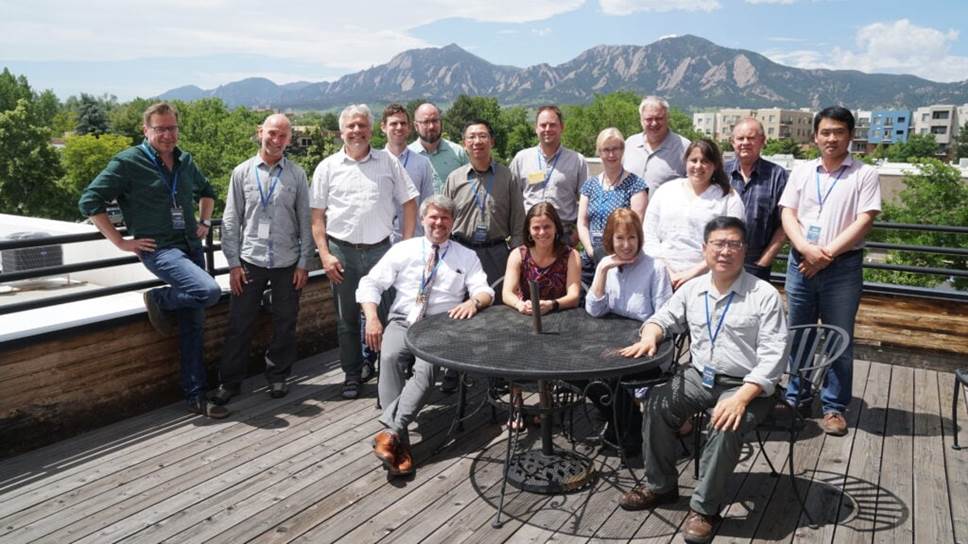
Participants in the GERI Governance Workshop, Boulder Colorado, June 2019.
Standing (from left to right) S. Zacharias (eLTER, Helmholz UFZ), M. Mirtl (eLTER, Helmholz UFZ), W. Kutsch (ICOS ERIC), M. Grant (TERN, U Queensland), G. Feig (SAEON, U Pretoria), J. Tang (NEON, Marine Biological Lab), B. Ruddell (Northern Arizona U), J. Bäck (eLTER, U Helsinki), H. Loescher (NEON, Battelle), M. A. Genazzio (NEON, Battelle), J. Pauw (SAEON, South Africa NRF), L. Zhang (CERN, CAS).
Sitting (from left to right) M. Hawkins (U.S. NSF, GSO Representative (Observer)), C. Schaedel (NEON, Northern Arizona U), B. Morris (TERN, U Queensland), and X. Yu (CERN, CAS).
Present but not pictured D. Hudnut (NEON, Grok Consulting).
