
ORGANISATIONS
ECOLOGICAL PROCESSES
DRIVERS OF CHANGE
§ Governance
We love cooperation.
Each of the six GERI observatories is equally important to monitoring Earth's ecosystems — and our governance has been designed to reflect exactly that balance.
§ 01 — Balance & equality
6 months
Each member RI rotates into the Governance Board chair every six months.
All of the GERI observatories are equally important to the monitoring of ecosystems on our planet, and the governance of the new global infrastructure has been designed to reflect this.
Regularly rotating the chair of the GERI Governance Board is just one of the ways in which GERI is demonstrating the balance among its members.
§ 02 — How we decide
GERI's system of governance utilises sociocracy principles — dynamic governance, built upon the trust and 'group understanding' established over several years' of catalytic workshops.
This approach does not infringe upon each member's fiduciary relationship with their respective sponsors and shareholders — a necessary requirement for international partnerships with different sponsors.
§ 03 — Landscape map
Hover over an organisation (or tap, on mobile) to see its data connections to ecological processes and drivers of change. Line thickness indicates the number of data products contributed.
About this diagram This is a conceptual Landscape map that demonstrates the collective suite of data that makes up the GERI. The data suites (fields) provided by the GERI-member Environmental Research Infrastructure are mapped against the drivers of changes (cause) and the ecological processes (effect). Each ERI is colour coded with weighted lines that quantitatively indicate the number of data products and the data suites they contribute towards the GERI.
§ Member observatories
GERI's governance brings together six continental-scale ecosystem research infrastructures, each holding equal weight in setting research priorities, sharing data, and shaping policy advice. Together they cover Africa, Asia, Australia, Europe (two networks), and North America.
Long-term observation of terrestrial, agricultural, and aquatic ecosystems across China, with emphasis on biogeochemical cycles and ecosystem services in a rapidly changing landscape.
Pan-European research infrastructure for long-term, in-situ research on ecosystems, critical zones, and socio-ecological systems, integrating observatories from across the continent.
Standardised, long-term observations of greenhouse gas concentrations and carbon fluxes between the atmosphere, land, and oceans across Europe and adjacent regions.
Continental-scale ecological observation across 81 field sites in the United States, collecting standardised data on biodiversity, ecosystem processes, and environmental change.
Long-term environmental observation across South African terrestrial and marine ecosystems, with strong emphasis on data stewardship, capacity building, and policy-relevant science.
Australia's land-based ecosystem observatory, providing open ecological data and infrastructure to track environmental change across the continent's diverse biomes.
§ 04 — Delivery
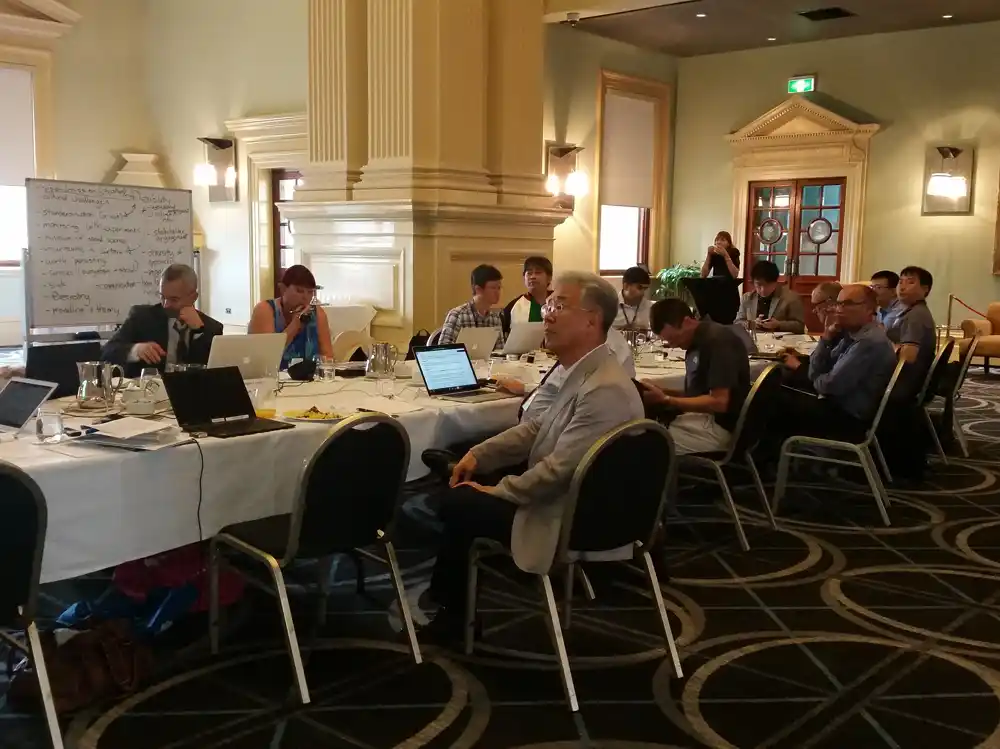
A suite of working groups is working to develop the common science questions, protocols, parameters, data systems and so on that will be adopted by GERI.
Online cadence
Governance Board meets bimonthly online.
In-person
Board meets at international conferences throughout the year.